

LDP Partial Hang Single Girder Overhead Crane: Ideal Solution for Low-Headroom Workshops


- A3
- A4
-

 Lifting hook
FEATURED PRODUCTS
-
 Explosion Proof Single Girder Overhead CraneApply: This crane adapts to the environment in factory that have explosive gas formed by inflammable gas, steam and air of which explosion proof grade is less than B grade or C grade and ignition group is more than T4 (135℃)group.LEARN MORE

-
 Rail Mounted Container Gantry CraneApply: A Rail Mounted Gantry (RMG) is a specialized material handling equipment used in ports , container terminals, and intermodal yards for efficient cargo movement .LEARN MORE
-
 LX Type Suspended Single Girder Overhead CraneApply: This crane is applicable in factories and warehouses where the height from the rail surface to the lower edge of the truss is equal to or shorter than 500mm. LEARN MORE
-
 Grab Double Girder Overhead CraneApply: The load handling device is the grab which is able to capture bulk materials.LEARN MORE
The LDP partial-suspension single girder overhead crane is an improved design developed from the conventional LD single girder overhead crane. Its electric hoist is partially suspended from the main girder, with part of the hoist assembly extending above the girder level. Compared with the standard LD model, this arrangement can provide greater effective lifting height under suitable installation conditions, making it a practical low headroom overhead crane solution for workshops with limited vertical clearance.
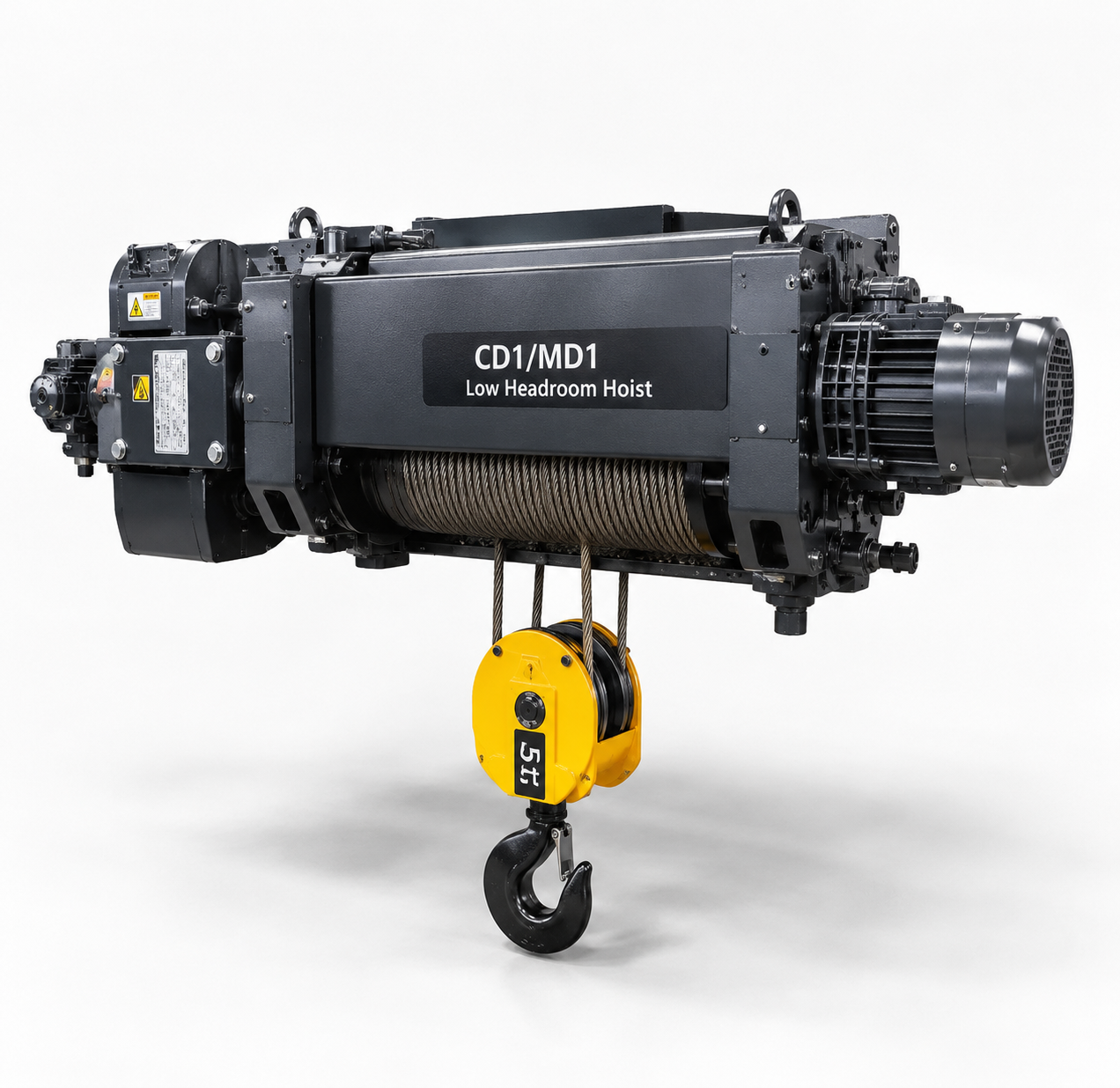
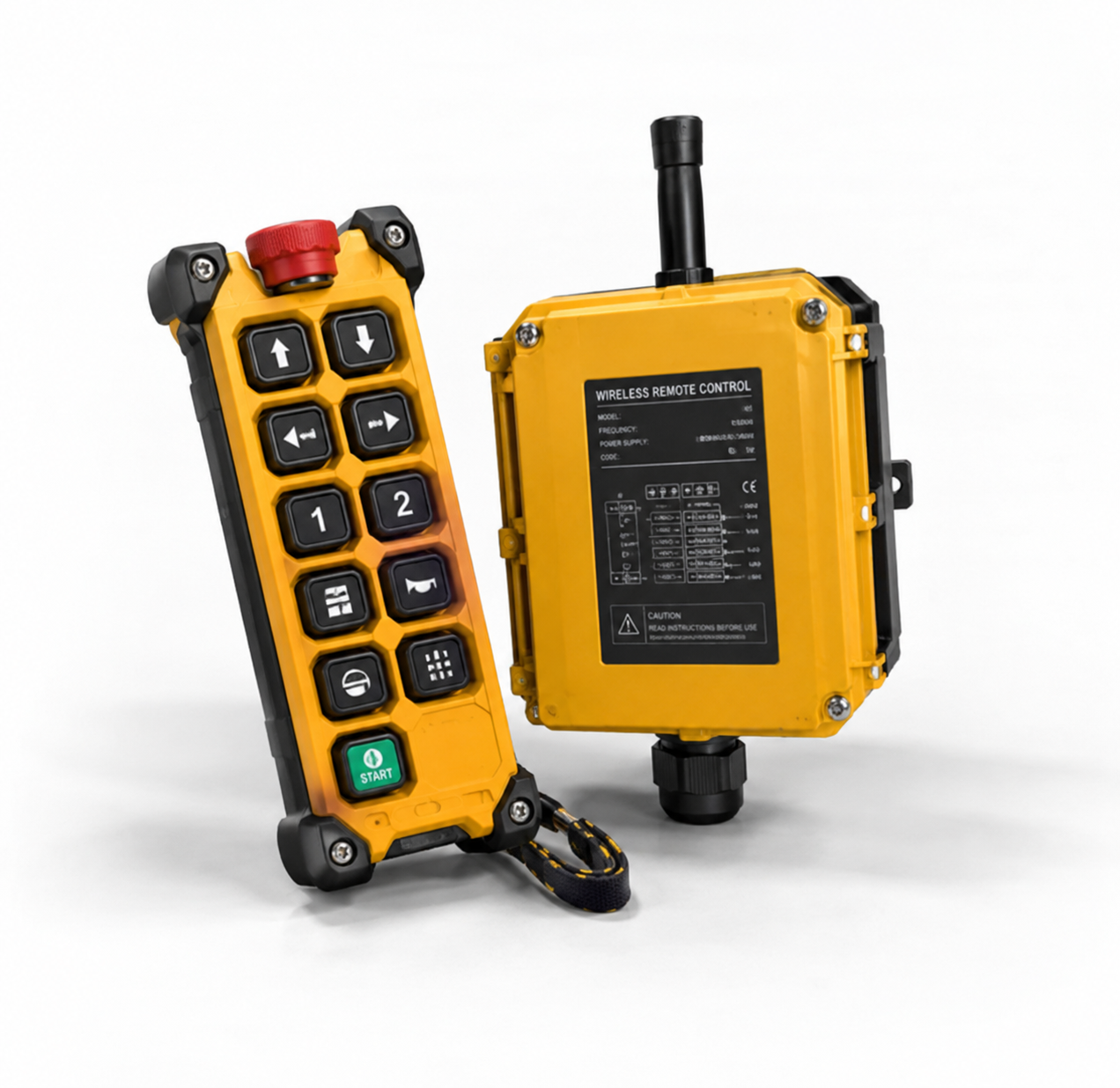
The crane can be equipped with a CD1 or MD1 wire rope electric hoist. Ground-level pendant control and radio remote control are available, while the rated lifting capacity and span can be customized to suit specific working conditions and workshop layouts.
Looking for an LDP single girder overhead crane price? Contact us to discuss your lifting requirements and request a customized quotation.
LD vs. LDP: Headroom and Lifting Height Comparison
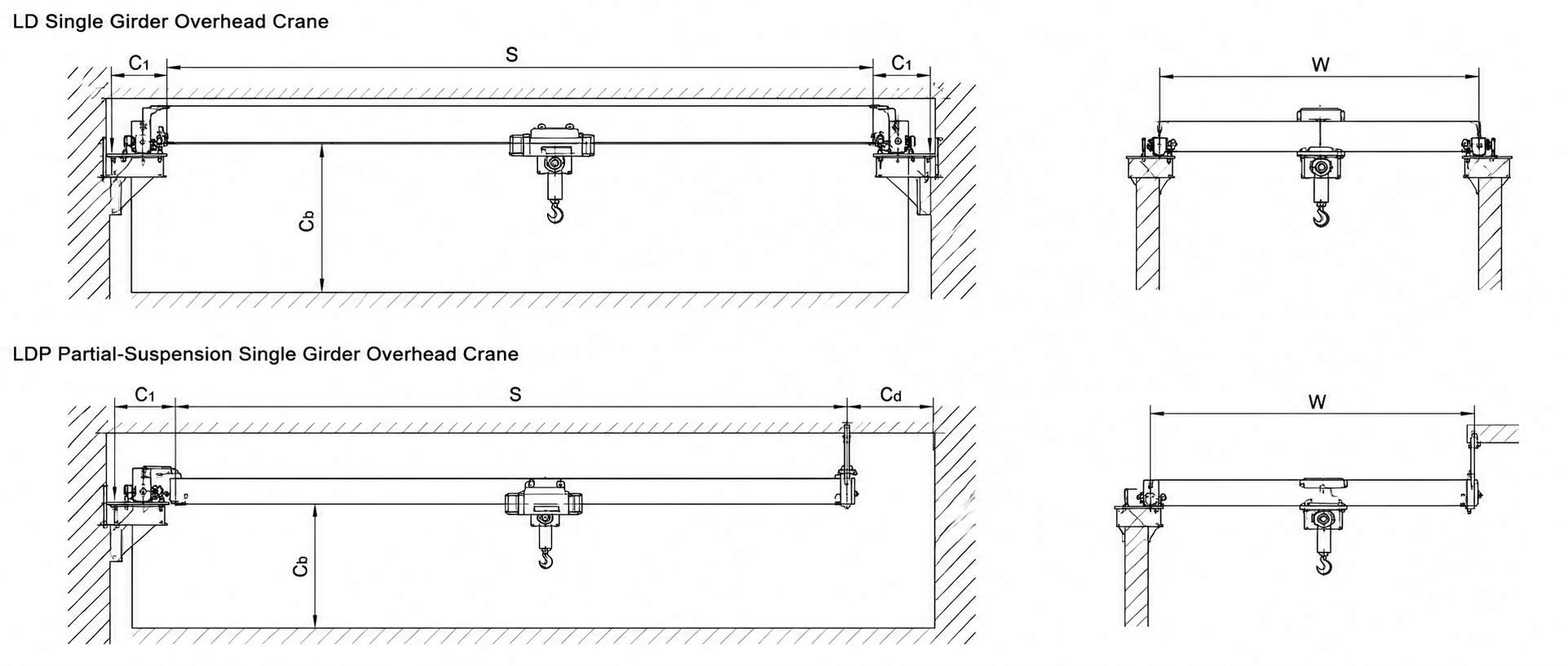
Comparison |
LD Single Girder Overhead Crane |
LDP Partial-Suspension Single Girder Overhead Crane |
Headroom |
The end carriages and crane girder occupy space below the runway beams, which may limit the available lifting height in workshops with low ceilings. |
The partial-suspension structure may allow the crane to be installed closer to the roof structure on the suspended side, helping make better use of available headroom. |
Lifting Height |
The actual lifting height depends on the building clearance, crane structure, and hoist configuration. |
The lifting height may be increased in suitable workshop layouts, depending on the suspension arrangement, structural clearance, and hoist configuration. |
Key Consideration |
Suitable when conventional runway beams are available and the required hook height can be achieved. |
Worth considering when workshop headroom is limited, provided the building structure can safely support the suspension loads. |
When comparing the LD and LDP overhead cranes, do not focus on the overall crane height alone. The available hook height is often more important. Before selecting a model, check the lowest point of the roof structure, the runway beam elevation, the dimensions of the hoist, and the required lifting height.
For workshop renovation projects, an LDP crane may be worth considering when the existing building cannot easily accommodate a conventional hoist arrangement. However, the actual lifting-height improvement depends on the equipment configuration and available structural clearance.
Product Features of the LDP Single Girder Overhead Crane
The LDP single girder overhead crane improves effective lifting height by raising the hoist arrangement relative to the main girder. Under suitable installation conditions, this design can provide additional hook travel without increasing the overall crane height.
1. Customized Design for Different Working Conditions
The rated lifting capacity, span, lifting height, and control configuration can be customized according to the customer's requirements. This allows the crane to be adapted to different workshop dimensions, material-handling tasks, and existing building structures.
2. Compatible with CD1 and MD1 Wire Rope Electric Hoists
The LDP crane can be equipped with CD1 or MD1 wire rope electric hoists. The hoist and electrical configuration should be selected according to the local power supply, required lifting speed, load capacity, and operating conditions. Power supply compatibility should be confirmed during the design stage.
3. Manufactured in Accordance with Relevant Crane Standards
The crane is manufactured with reference to JB/T 1306-2008 and GB/T 3811, as specified for the product. These standards relate to electric wire rope hoists and crane design, respectively. The applicable editions and compliance requirements should be confirmed for each project.
4. Multiple Control Options
Available operating configurations can include ground-level pendant control, radio remote control, and cabin control, subject to the final design. The appropriate option depends on the operator's working position, visibility of the lifting area, and site safety requirements.
5. Safety Devices Tested Before Delivery
The crane's safety devices are checked and tested before delivery. The final safety configuration depends on the crane design, applicable standards, and project requirements. Installation, commissioning, and on-site safety checks should also be completed before the crane is put into service.
6. Suitable for Low-Ceiling Workshops and Renovation Projects
The LDP partial-suspension overhead crane is worth considering for low-headroom workshops, existing factory upgrades, and workstations with limited vertical clearance. Its suitability should be evaluated against the required hook height, available building clearance, runway arrangement, and structural load capacity.
For an existing workshop, checking these conditions before ordering can help avoid choosing a crane that fits the building but cannot lift materials to the required height.
What Should Be Checked Before Choosing an LDP Crane?
1. Available Headroom
You need to check not only the height from the roof to the floor but also whether there are any obstacles within this space, including but not limited to workshop beams, pipelines, and cable trays. These obstacles may affect the crane's installation dimensions and operating clearance, so they should be considered during low headroom crane selection.
2. Required Hook Height
The height to which the hook needs to be lifted is equally important. The hoist body, which extends above the main girder, will occupy some of the overhead space and reduce the available upward travel of the hook. Therefore, check the LDP overhead crane dimensions against the clearance required for lifting your goods to avoid insufficient lifting height after installation. The overhead crane required hook height should be confirmed before the crane configuration is finalized.
3. Runway Beam and Supporting Structure
The load positions of the LDP and LD trolleys are different. The center of gravity of the LDP trolley and its lifted load is offset to one side, while the LD trolley is positioned in the middle of the main girder. As a result, when an LDP crane runs along the runway, the wheel loads are asymmetrical.
For existing workshop renovation projects, it is recommended to provide the dimensions of the existing runway beams, supporting structure information, and on-site photos before finalizing the crane configuration. This allows engineers to evaluate the load-bearing capacity and confirm whether the existing structure can support the LDP crane.
The supporting structure on the suspended side of an LDP crane must be checked through structural calculations. It should not be assumed that an ordinary workshop roof structure can directly support the crane without verification. These checks are important LDP crane installation requirements.
LDP Overhead Crane Components and Accessories
Mine Crane provides crane components and accessories, including electric hoists and main girders. Replacement components can be discussed with our team when maintenance or repairs are required. Compatibility should be confirmed against the original crane specifications before ordering.
Request a Quote for an LDP Partial-Suspension Overhead Crane
If you are looking for an overhead crane for a low-ceiling workshop or an existing factory, provide the following details to help us evaluate a suitable configuration:
Required rated lifting capacity
Crane span and available installation space
Required hook height and actual lifting height
Workshop drawings or existing runway dimensions, if available
Local power supply and preferred control method
Working conditions and lifting frequency
With this information, we can assess whether an LDP partial-suspension single girder overhead crane is suitable for your workshop and prepare a configuration based on your specific requirements.
LDP partial-suspension overhead cranes are suitable for workshops where conventional single girder cranes cannot provide the required hook height. They can be considered for existing factory renovations, machinery manufacturing workshops, equipment assembly areas, and warehouses with limited overhead clearance.
Before selecting an LDP crane, the available roof clearance, runway arrangement, required lifting height, and supporting structure should be checked to determine whether the partial-suspension design is suitable.


