

LX Type Suspended Single Girder Overhead Crane


- A3
- A4
- A5
-

 Lifting hook
FEATURED PRODUCTS
-
 Double Girder Grab Gantry CraneApply: Electric double girder rail travelling gantry crane with bucket is usually used in open-air warehouses or along railways. such as coal blocks and sand.LEARN MORE

-
 European Single Beam Bridge CraneApply: It is widely used machinery manufacture, warehouse, logistic, food, paper making, electronics industries workshop and other material handling situations.LEARN MORE
-
 Shipyard CraneApply: Shipyard Crane is special for fragmented transport, end-to-end jóoint and turning operation of large ship hulls.LEARN MORE
-
 Rubber Tyre Container CraneApply: Rubber-tyred Container Gantry Cranes are applicable to remove, load and unload international standard containers.LEARN MORE
LX Suspension Overhead Crane Overview
The LX suspension overhead crane, also described as an electric single girder suspension overhead crane, is designed for light-duty material handling in workshops and production areas. It can be equipped with a CD1 or MD1 electric wire rope hoist, depending on the required configuration. In product listings, this model may also be referred to as an LX-Suspension Overhead Crane.
Like a conventional LD single girder overhead crane, the LX crane uses an electric hoist to lift loads and can travel along the length of a workshop. As an underslung single girder overhead crane, it hangs from runway tracks installed beneath a suitable overhead supporting structure, rather than running on elevated runway rails like a typical LD crane. This electric hoist suspended overhead crane arrangement affects the load path, installation requirements, and the loads transferred to the building.
LX vs. LD Single Girder Overhead Cranes
Similarities
1. Main components: Both crane types generally include a main girder, end carriages, an electric hoist, a lifting mechanism, and an electrical control system. The detailed running and connection arrangements may differ.
2. Control methods: Both can be operated by pendant control or radio remote control, depending on the configuration.
3. Applications: Both are used for light- to medium-duty material handling in workshops, warehouses, and production areas. The suitable rated capacity depends on the specific crane design and operating conditions.
Key Differences
Comparison Item |
LX Suspension Overhead Crane |
LD Single Girder Overhead Crane |
Installation method |
The crane is suspended from runway tracks installed beneath an engineered overhead supporting structure. |
The end-carriage wheels run on elevated runway rails, which are supported by runway beams, columns, corbels, or other suitable structures. |
Load path |
Lifted load → main girder → suspension running mechanism → runway track → overhead supporting steelwork → building structure. |
Lifted load → main girder → end-carriage wheels → runway rail → runway beam → supporting columns or other structure → foundation, where applicable. |
Installation requirements |
The overhead supporting structure, runway tracks, suspension points, and connections must be checked for the crane’s dead load and operating loads. |
The runway rails, runway beams, supporting columns or corbels, connections, and foundations must be checked as applicable. |
Span |
The achievable span depends on the main-girder design, suspension spacing, runway arrangement, rated capacity, and the load-bearing capacity of the building structure. |
The achievable span depends on the main-girder design, rated capacity, runway system, and supporting structure. The actual range must be confirmed for the selected model. |
Loads on the building |
Particular attention should be paid to the overhead steel structure and the points where the suspended runway transfers loads into the building. |
Particular attention should be paid to the runway beams and their supports, including columns, corbels, and foundations where applicable. |
Headroom and hook height |
The suspended arrangement occupies space below the runway. The available hook travel and highest hook position depend on the runway elevation, girder and hoist dimensions, and upper-limit setting. |
The available hook travel and highest hook position depend on the runway elevation, girder dimensions, hoist configuration, and upper-limit setting. Neither type automatically provides more hook height in every installation. |
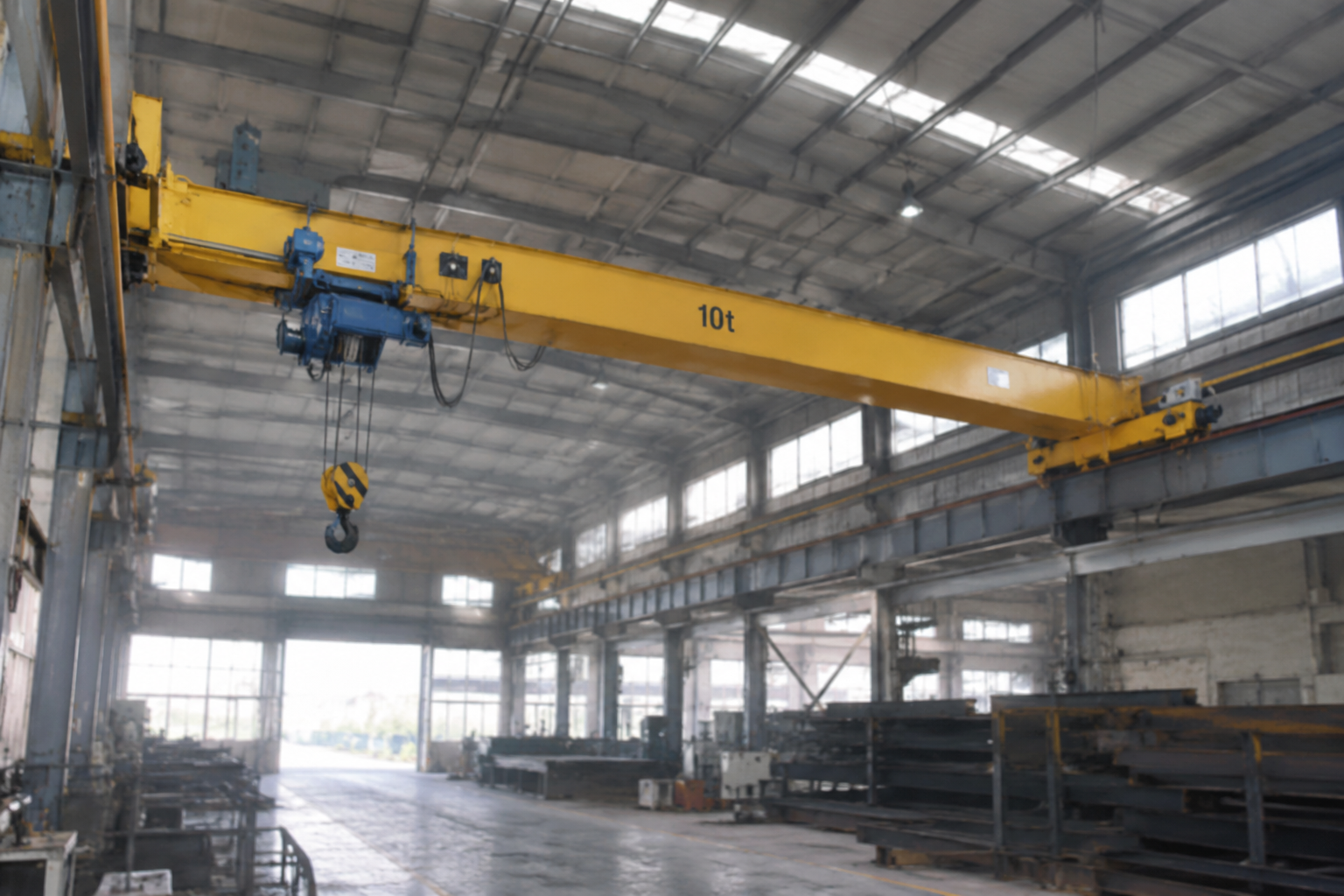
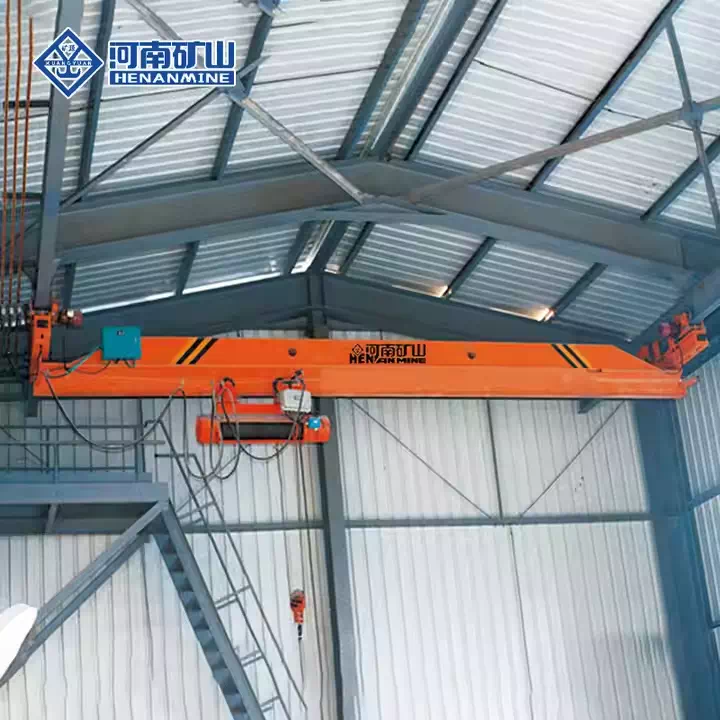
When Should You Choose an LX Suspension Overhead Crane?
1. When installing floor-supporting columns is difficult or undesirable
An LX suspended overhead crane for workshops may be worth considering when floor space is limited or additional floor-supported columns would interfere with production equipment, forklift routes, or material flow. The existing overhead structure must still be suitable for the crane loads.
2. When suitable overhead steel beams are available
In some workshops, the suspended runway may be attached beneath existing I-beams or H-beams. These checks are a key part of suspended overhead crane installation requirements: the beams and their connections must be structurally checked before installation. Their appearance or size alone does not confirm that they can safely support the crane’s dead load, lifted load, and operating forces.
3. For light-duty material handling
The LX single girder suspended crane is commonly used to move motors, mechanical parts, fixtures, and small equipment in assembly workshops, production areas, and maintenance zones. The LX overhead crane for light-duty material handling can help move loads between workstations, provided the rated capacity and working duty match the actual lifting cycle.
4. When the required hook travel can be achieved within the available headroom
The main girder, suspension components, and hoist occupy part of the vertical space below the runway. Before selecting an LX overhead crane, confirm both the required hook travel and the required highest and lowest hook positions. The effective hook travel should not be estimated simply by subtracting the crane structure height from the building height; it must be checked against the actual installation dimensions and hoist limits.
5. When loads need to be handled near the runway ends
Depending on the end-carriage, hoist, and runway design, an LX suspended single girder crane may allow the hook to approach the runway ends. Confirm the end approach dimensions on the selected layout drawing, because the actual reachable area varies by configuration.
When Is an LX Suspension Overhead Crane Not the Right Choice?
1. The overhead steel structure or its connections cannot safely carry the required crane loads and cannot be suitably reinforced.
2. The required span, rated capacity, or working duty is beyond the capability of the proposed LX design.
3. The required hook height or hook travel cannot be achieved because of limited headroom or the selected hoist arrangement.
LX Suspension Overhead Crane Technical Parameters
Parameter |
Technical Specification |
Crane Model |
LX Series |
Crane Type |
Suspended Single Girder Overhead Crane |
Lifting Capacity |
0.5–10 t* |
Span |
3–16.5 m* |
Lifting Height |
6–30 m* |
Lifting Mechanism |
Electric Hoist |
Hoist Type |
Wire Rope Hoist or Chain Hoist, depending on the configuration |
Traveling Speed |
Customized according to operating requirements |
Hoisting Speed |
Selected according to lifting capacity and hoist configuration |
Control Method |
Pendant Control / Radio Remote Control |
Power Supply |
3-phase AC, 380 V, 50 Hz* |
Working Duty |
Selected according to the actual operating cycle |
Installation Type |
Suspended from an engineered overhead runway system |
Operating Environment |
Indoor industrial environments; special environments require a separately confirmed configuration |
When comparing LX crane lifting capacity and span, the values below should be treated as indicative rather than universal limits. The capacity, span, lifting height, and power supply must be verified against the actual LX product range and project requirements before publication.
The LX Single Girder Suspension Crane is not limited to one fixed set of specifications. A customized LX suspension overhead crane can be configured for span, rated capacity, working duty, lifting height, and other features according to the actual operating conditions and workshop layout. Contact Mine Crane to discuss your installation requirements and a suitable LX overhead crane configuration.
The LX Electric Hoist Single Beam Overhead Traveling Crane is mainly used for light-duty material handling in mechanical processing workshops, equipment assembly areas, small-parts warehouses, storage zones, and production lines. An LX single girder suspended crane with electric hoist can help move components between workstations when the building structure and suspended runway system are suitable for the required loads. It is a practical option for light-duty workshop material handling where an engineered overhead support is available.


