

Explosion Proof Single Girder Overhead Crane


- A3
-

 Lifting hook
FEATURED PRODUCTS
-
 A typed Double Girder Hook Gantry CraneApply: Double glider gantry cranes with hook are available for general service, such as loading, unloading,lifting and transferring work in outdoor storage oron railways.LEARN MORE

-
 Double Girder Grab Gantry CraneApply: Electric double girder rail travelling gantry crane with bucket is usually used in open-air warehouses or along railways. such as coal blocks and sand.LEARN MORE
-
 LDC electric single-girder craneApply: LDC electric single-girder crane is applicable to the places where the workshop is low and the requirement of lifting height is high.LEARN MORE
-
 Insulation Double Girder Overhead CraneApply: The crane is applicable to aluminum and magnesium smelting factories.LEARN MORE
An explosion-proof single girder overhead crane is designed for industrial environments where explosive gases or combustible dust may be present. Depending on the hazardous-area classification and application requirements, explosion-protection measures may be incorporated into the electrical equipment, drive systems, brakes, and other relevant components to help reduce the risk of ignition.
As an experienced crane manufacturer, Mine Crane supplies LB-type, LXB-type, and other explosion-proof crane configurations for different material handling applications. If your facility has specific explosion-protection or lifting requirements, contact us to discuss a suitable crane solution.
LB vs. LXB Explosion-Proof Single Girder Overhead Cranes
Both LB-type and LXB-type explosion-proof single girder overhead cranes can be configured with explosion-protected electrical equipment and compatible explosion-proof electric hoists, such as BCD or HB series models, depending on the product configuration.
The main difference between these two types is their installation method and supporting structure.
LB-Type Explosion-Proof Single Girder Overhead Crane
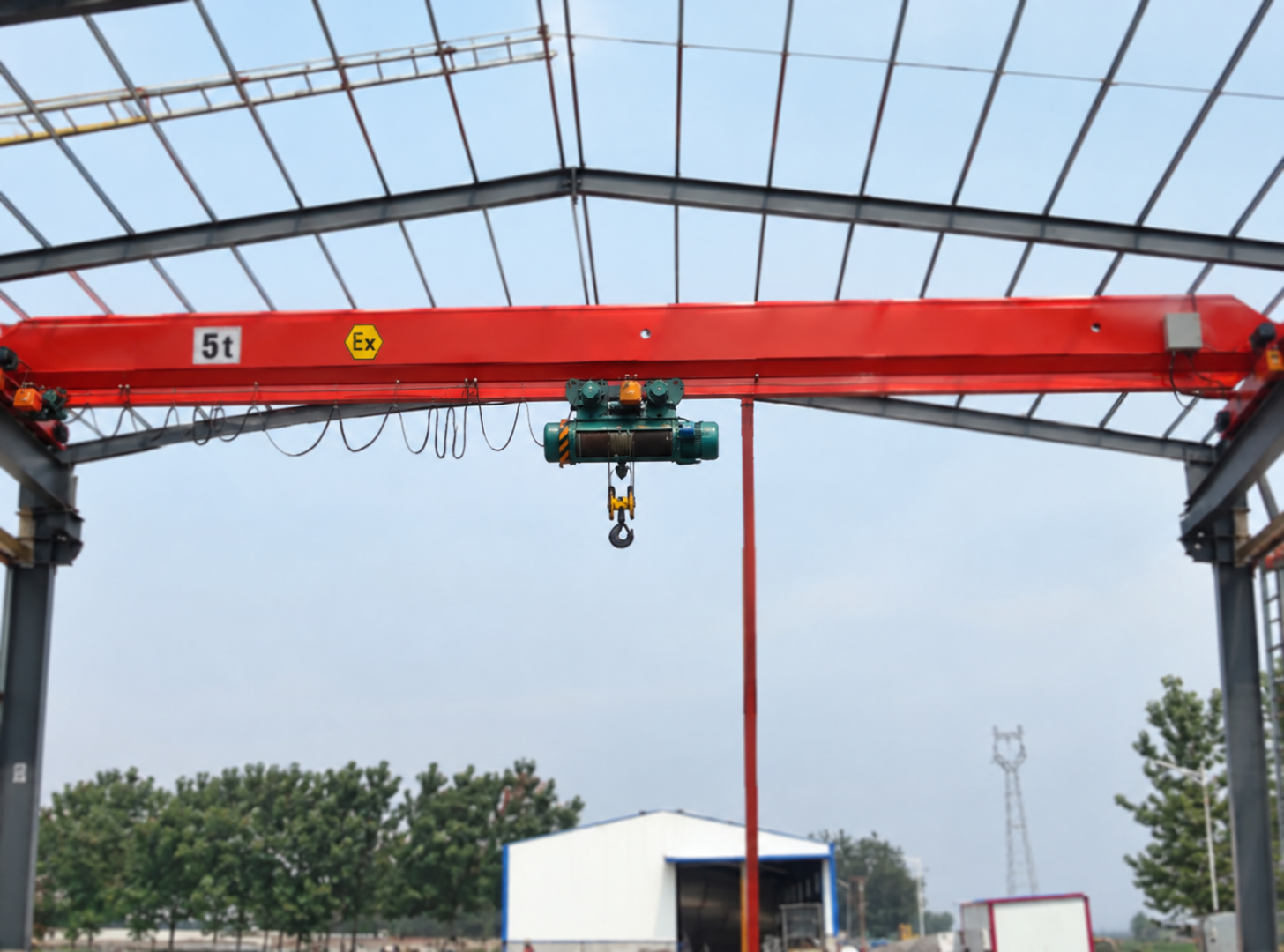
An LB-type explosion-proof overhead crane typically runs on elevated runway rails supported by building columns, brackets, or other suitable support structures. The crane loads are transferred through the runway system to the supporting structure and, ultimately, the building or foundations.
This configuration may be suitable when the building has adequate runway supports or when a dedicated supporting structure can be installed.
LXB-Type Explosion-Proof Single Girder Overhead Crane
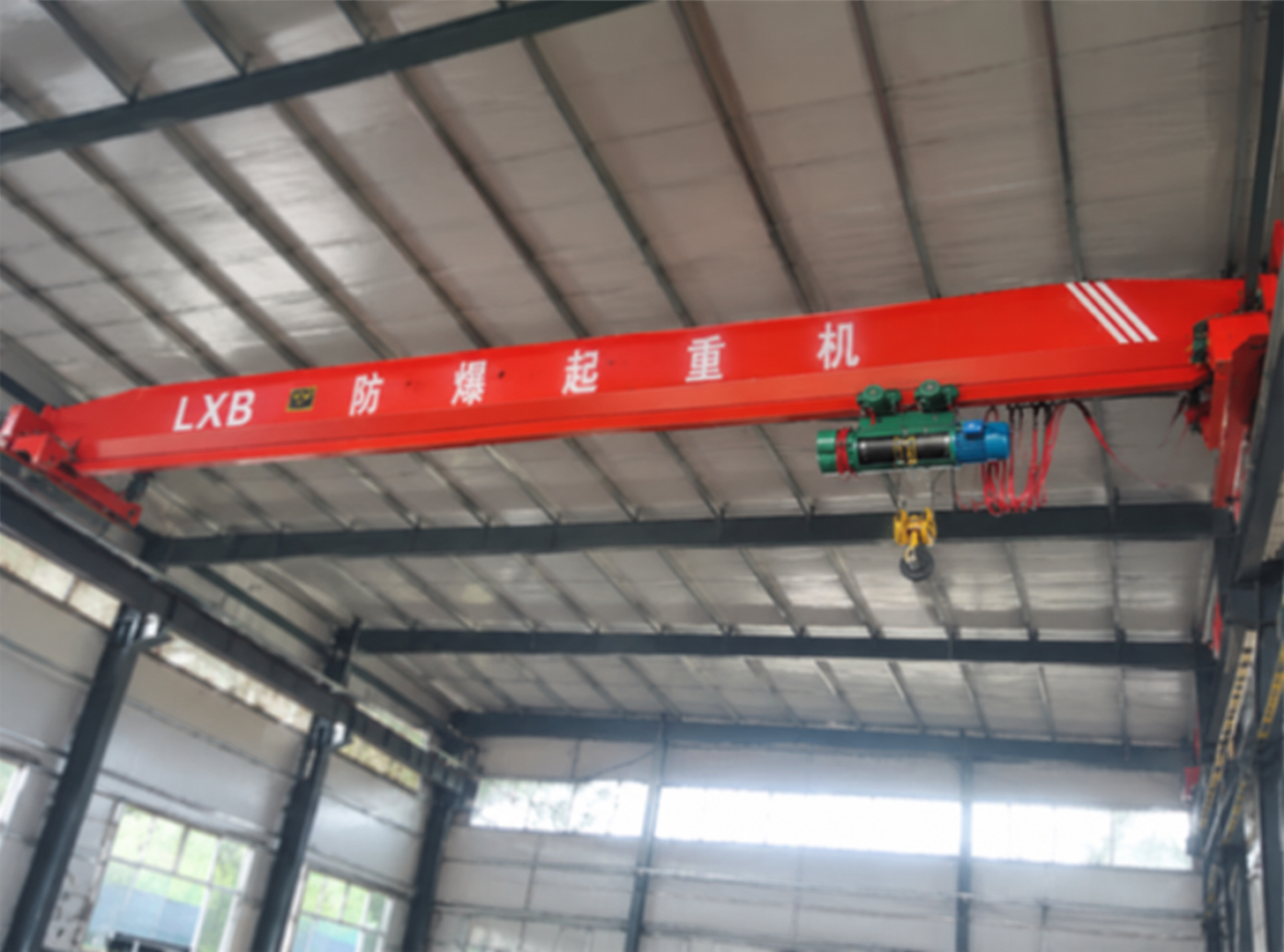
An LXB-type explosion-proof overhead crane typically uses a suspended runway system attached to the building's overhead structure. The crane loads are transferred through the suspended rails and their connections to the supporting structure.
Because the building structure must carry these loads, the supporting beams, suspension connections, and overall structural capacity should be evaluated before installation.
How to Choose Between LB and LXB Types
The right explosion-proof overhead crane depends on the required lifting capacity, span, available headroom, building layout, and supporting structure.
LB-type explosion-proof overhead crane may be considered when:
The required lifting capacity or span exceeds the design range of the available LXB-type models.
The existing overhead structure cannot safely support a suspended runway system, and a suitable independent support structure can be provided.
The facility already has suitable columns, runway brackets, or other supporting structures that can accommodate the crane loads.
LXB-type explosion-proof overhead crane may be considered when:
The application involves relatively light loads within the manufacturer's specified capacity range.
The building layout and span are suitable for a suspended runway system.
Floor space is limited and installing additional support columns would interfere with production, storage, or material handling.
The lifting capacity and span limits vary by product design. Requirements such as a lifting capacity of 5 tonnes or more, or a span exceeding 16 metres, should be checked against the manufacturer's actual specifications rather than treated as universal limits. A structural assessment is also necessary before selecting a suspended crane.
Explosion-Proof Gas Groups: IIB vs. IIC and Temperature Classes
When selecting an explosion-proof single girder overhead crane, the gas group and temperature class must match the hazardous atmosphere in which the equipment will operate.
IIB Gas Group
IIB is a gas group used for equipment intended for specified explosive gas atmospheres. Applications may include certain petrochemical processes, paint-related operations, pharmaceutical solvent handling, and fuel storage facilities, depending on the actual substances and hazardous-area classification.
IIB should not be regarded as a universal explosion-protection rating for all factories. The appropriate gas group must be determined from the gases or vapours present and the requirements of the hazardous area.
IIC Gas Group
IIC is a more stringent gas group than IIB. Hydrogen and acetylene are typical examples of gases associated with IIC requirements.
Where hydrogen or acetylene may be present, the hazardous-area assessment should determine whether IIC-rated equipment is required. Potential applications include hydrogen production, hydrogen-related facilities, and other industrial processes involving gases that require IIC protection.
Can IIC equipment be used in an IIB area? In general, equipment with an appropriate IIC gas-group rating can be suitable for an area requiring IIB gas-group protection. However, the temperature class, equipment protection level, hazardous-area classification, certification, and any certificate-specific conditions must also be suitable.
Choosing IIC equipment is not automatically necessary for an IIB area. The final selection should be based on the actual site requirements and the equipment's verified markings.
Temperature Classes: T1–T6
The temperature class specifies the maximum surface temperature that equipment may reach under its defined operating conditions. It helps prevent hot surfaces from becoming ignition sources in an explosive gas atmosphere.
As the temperature-class number increases, the permitted maximum surface temperature decreases.
T1 |
450° |
|
T2 |
300° |
|
T3 |
200° |
|
T4 |
135° |
|
T5 |
100° |
|
T6 |
85° |
When discussing an explosion-proof overhead crane with a manufacturer, provide details of the combustible gases or vapours present and their ignition temperatures. The selected equipment must have a suitable temperature class for the application.
Important selection notes:
IIB and IIC identify gas groups, while T1–T6 identify temperature classes for explosive gas atmospheres.
Gas group and temperature class are separate requirements; satisfying one does not automatically satisfy the other.
For combustible dust environments, dust-specific classification and maximum surface-temperature requirements must be evaluated separately.
Final suitability depends on the hazardous-area classification, actual substances present, equipment markings, and applicable certification requirements.
Choosing an Explosion-Proof Electric Hoist
An explosion-proof single girder overhead crane can be paired with different types of explosion-proof electric hoists, depending on the crane design and operating environment.
Potential options include:
BCD explosion-proof wire rope electric hoist
BMD explosion-proof wire rope electric hoist
HB explosion-proof electric hoist series
HBS explosion-proof electric hoist series
Explosion-proof electric chain hoist
Key Features of an Explosion-Proof Single Girder Overhead Crane
Multiple Control Options
Depending on the crane configuration and site requirements, control options may include a wired explosion-proof pendant, a compatible explosion-proof radio remote control, or cabin operation.
For wireless control, confirm that the remote control is suitable for the intended hazardous area and compatible with the crane's control system. An IP65 ingress protection rating indicates protection against dust ingress and water jets under specified test conditions; it does not, by itself, establish explosion-proof suitability.
Explosion-Protection Measures for Key Crane Components
An explosion-proof overhead crane requires a coordinated approach to explosion protection. The hoisting mechanism, travel motors, brakes, electrical control system, and relevant electrical components must be suitable for the intended hazardous area.
The complete configuration should be assessed against the applicable requirements. The presence of individual explosion-protected components does not, by itself, establish that the entire crane meets all required explosion-protection conditions.
Measures to Reduce Mechanical Spark and Ignition Risks
Depending on the application, suitable materials or protective structures may be used to reduce the risk of mechanical sparks caused by contact or impact between components.
For example, copper alloys or other appropriate materials may be used in selected components where the design calls for them. Material selection alone, however, cannot guarantee that a crane is spark-free. Mechanical contact, surface temperature, static electricity, operating conditions, and other potential ignition sources must also be considered.
FAQ
Q:What is the difference between an explosion-proof electric hoist and a standard electric hoist?
A:An explosion-proof electric hoist is designed and configured for specified hazardous environments. Depending on its protection concept, it may incorporate suitable motors, electrical equipment, enclosures, braking components, and measures to control potential ignition sources.
A standard electric hoist should not be assumed suitable for an explosive atmosphere unless its suitability for the specific application has been verified.
Q:Does your explosion-proof single girder overhead crane have ATEX or IECEx certification?
A:Certification availability depends on the specific crane model, supplied components, configuration, and target market. Please contact Mine Crane for the applicable certificates, equipment markings, and technical documentation for your proposed configuration.
For projects in Russia or other markets requiring additional conformity documentation, the applicable EAC Ex requirements should also be confirmed.
Q:What industries use explosion-proof single girder overhead cranes?
A:Explosion-proof single girder overhead cranes may be used in chemical processing, oil and gas facilities, pharmaceutical production, paint manufacturing, and other industrial environments where explosive atmospheres may occur.
The crane must be selected according to the actual hazardous materials, area classification, lifting requirements, and operating conditions.
Q:Can a standard overhead crane be converted into an explosion-proof crane?
A:Conversion may be possible in some cases, but replacing only the motor or electrical components is not necessarily sufficient. The complete crane system must be assessed, including brakes, electrical controls, mechanical contact risks, surface temperatures, and other potential ignition sources.
A qualified manufacturer or engineer should determine whether the existing crane can be modified to meet the required explosion-protection specifications.
Q:Can IIC explosion-proof equipment be used in an IIB workshop?
A:Generally, IIC-rated equipment can be suitable for an area requiring IIB gas-group protection, provided that all other requirements are also met. These include the temperature class, hazardous-area classification, equipment protection level, certification, and any applicable special conditions.
Although IIC may offer a broader gas-group suitability, it may not be necessary for every IIB application. The appropriate specification should be determined from the site's risk assessment and equipment requirements rather than price alone.
Q:What information should I provide when requesting a quotation?
A:To help identify a suitable explosion-proof single girder overhead crane, provide the following information where available:
Rated lifting capacity and lifting height
Crane span and required travel distance
Operating frequency and duty requirements
Installation layout and supporting structure details
Type of hazardous gas, vapour, or combustible dust
Hazardous-area classification and required explosion-protection markings
Required temperature class and applicable certification requirements
Target country or market
With these details, the manufacturer can evaluate the crane structure, hoist configuration, control method, and explosion-protection requirements more accurately.
Contact Mine Crane to discuss your lifting requirements and request a suitable explosion-proof single girder overhead crane configuration.
This crane adapts to the environment in factory that have explosive gas formed by inflammable gas, steam and air of which explosion proof grade is less than B grade or C grade and ignition group is more than T4 (135℃)group. And the explosion proof electric hoist adapts to 1 area or 2 area, not 0 area.


