

Double-Purpose Bridge Crane with Grab and Hook


- A6
-

 Lifting hook
-

 Grab bucket
FEATURED PRODUCTS
-
 Mini Gantry CraneApply: Workshop/Warehouse/Factory/Small equipment installation/goods and work piece handing. This crane is designed for transporting and positioning materials.LEARN MORE

-
 U typed Double Girder Hook Gantry CraneApply: The machine is suitable for railway freight yards, ports, open warehouses, container transfer stations, etc. with large span and frequent loading and unloading operations.LEARN MORE
-
 Four Girder Ladle CraneApply: Casting bridge cranes are the main handling equipment for smelting workshop of steel works. They are used for conveying, pouring and hot metal charging of liquid metal in smelting process.LEARN MORE
-
 Flexible KBK CraneApply: It is suitable for conveyor/product/industrial lines in general workshops/warehouses and modern production.LEARN MORE
QN Double-Purpose Bridge Crane with Grab and Hook, also known as a QN Grab and Hook Overhead Crane, is designed with two independent hoisting mechanisms: one for grab operation and the other for hook lifting. This design helps meet different material handling requirements.
The two hoisting mechanisms are designed for different lifting tasks and cannot operate at the same time. During each operation, only one working mode can be selected.
By integrating grab and hook functions into the same overhead crane, this double-purpose bridge crane can handle both bulk material grabbing and general cargo lifting. It can reduce the need to purchase two separate lifting machines, helping lower equipment investment and reduce the number of machines and the amount of space occupied inside the workshop.
Design of Double-Purpose Bridge Crane with Grab and Hook
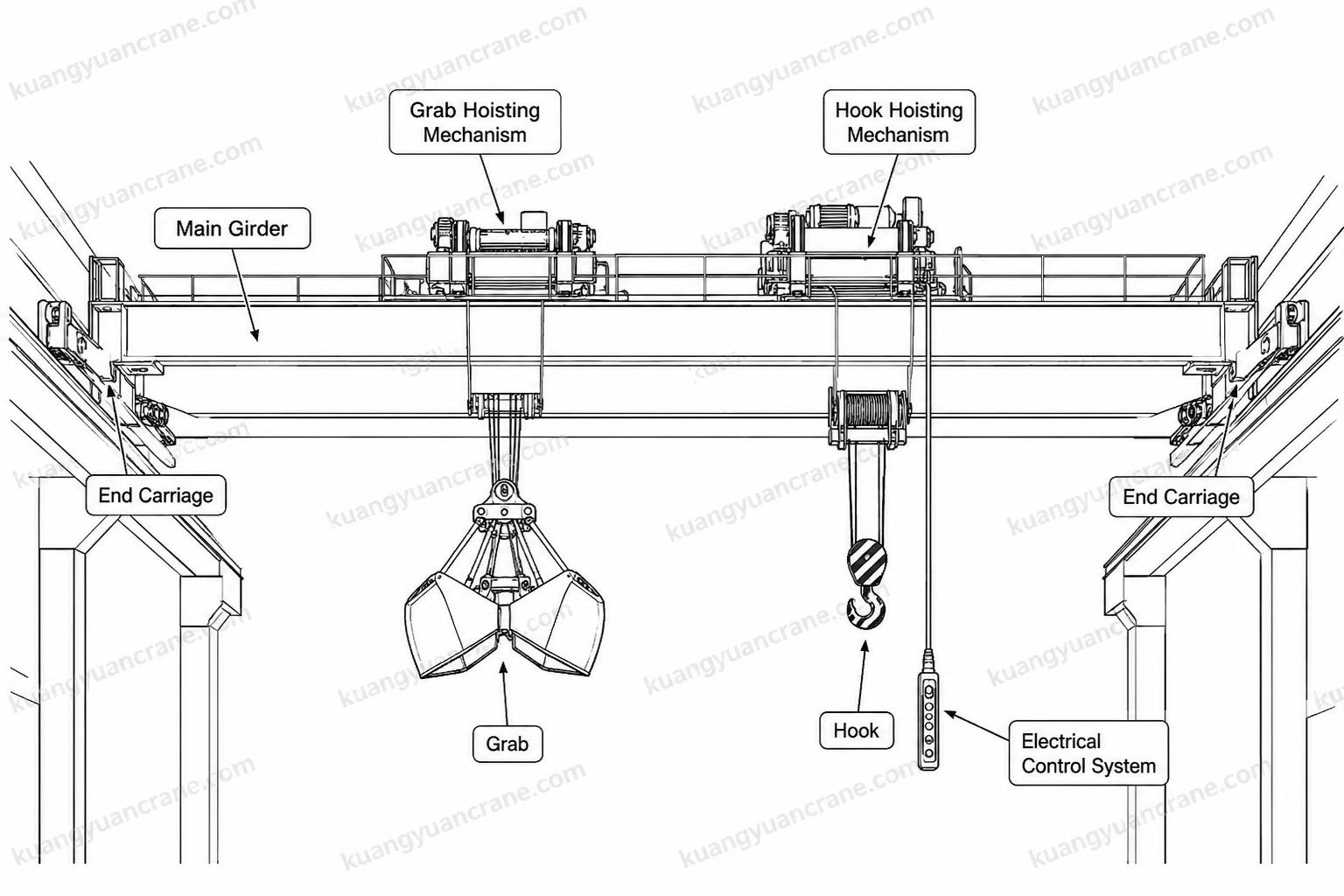
As shown in the design drawing, the main difference between this Double-Purpose Bridge Crane with Grab and Hook and a conventional overhead crane is that it is equipped with both a hook and a grab.
The hook can be used to lift shaped steel, motors, and other equipment, while the grab can handle bulk materials such as sand, crushed stone, barley, and corn. The following section explains the basic structure of this overhead crane for bulk and general cargo handling and the function of each component.
Basic Structure and Functions
The QN Grab and Hook Overhead Crane is a type of dual hoisting mechanism overhead crane. Its basic structure includes the following components:
Main Girder: The main girder is the primary load-bearing structure of the crane. During the design stage, the lifting capacity, operating requirements, span, and hook configuration need to be determined.
End Carriages: The end carriages are connected to both ends of the main girder and support the crane travelling mechanism.
Grab Hoisting Mechanism: The grab is used for handling bulk materials. Different grab types can be selected or designed according to the material, such as clamshell grabs and orange peel grabs.
Hook Hoisting Mechanism: The hook is used for lifting shaped or individual loads, such as steel structures, steel plates and sections, electromechanical equipment, molds, packing cases, spare parts, and other individual heavy loads.
The grab and hook hoisting mechanisms are designed for different lifting tasks. During grab and hook crane operation, only one mechanism can operate at a time, while the other remains inactive.
Trolley / Trolley Arrangement: In general, the two hoisting mechanisms share an integrated trolley frame. For special requirements, the manufacturer may design the crane with two separate trolleys.
Electrical Control System: The electrical control system controls the hoisting, crane travelling, and trolley travelling movements. According to different material handling tasks, the operator can select either the grab or hook operating mode. Cab control, wired pendant control, and wireless remote control can also be configured according to customer requirements.
Technical Parameters
Parameter |
Unit |
5+5 |
10+10 |
16+16 |
25+25 |
Lifting Capacity |
t |
5+5 |
10+10 |
16+16 |
25+25 |
Working Class |
/ |
A6 |
A6 |
A6 |
A6 |
Span |
m |
10.5~22.5 |
10.5~25.5 |
10.5~28.5 |
10.5~31.5 |
Max. Lifting Height |
m |
9 |
12 |
14 |
16 |
Lifting Speed |
m/min |
10.0 |
8.0 |
6.3 |
4.8 |
Grab Travelling Speed |
m/min |
46 |
42 |
32 |
32 |
Crane Travelling Speed |
m/min |
78 |
72 |
65 |
58 |
The above parameters are for reference. The final crane configuration can be determined according to the actual lifting requirements and working conditions.
What Can You Gain from a Double-Purpose Crane?
Make Better Use of Existing Crane Runways and Workshop Space
If a workshop uses both a hook overhead crane and a grab overhead crane, two separate crane units are normally required. This may require more crane-related infrastructure and occupy more workshop space.
One QN Double-Purpose Bridge Crane with Grab and Hook can handle both bulk materials and individual loads. The two operating functions can share the same crane runway, helping reduce the space occupied by separate lifting equipment.
Reduce Equipment Procurement Costs
If a workshop needs to handle both bulk materials and shaped loads, two different types of cranes may normally be required. A QN Double-Purpose Bridge Crane with Grab and Hook combines these two functions into one crane.
This can reduce the need to purchase two separate crane units. The actual cost difference depends on the crane capacity, span, configuration, and working conditions.
Simplify On-Site Equipment Management
Using one double-purpose crane can reduce the number of separate lifting machines that need to be managed on site. Operators can select either the grab or the hook according to the current material handling task.
Because the grab and hook are equipped with separate hoisting mechanisms, there is no need to frequently remove and replace lifting attachments when switching between the two types of material handling tasks. When the two operations are performed alternately, this design can make the material handling process more continuous.
QN vs. QD vs. QZ Overhead Cranes
Comparison |
QN |
QD |
QZ |
Lifting Tool |
Grab + Hook |
Hook |
Grab |
Suitable Materials |
Bulk materials + shaped loads |
Shaped loads |
Bulk materials |
Operational Flexibility |
High. The grab or hook can be selected according to the task |
Used for lifting regular, individual, shaped loads or combined heavy loads |
Suitable for granular, powdered, and bulk materials. Flat-edge or toothed grabs can be selected according to the material |
Suitable for Two Types of Materials |
Yes |
No |
No |
Typical Application |
Limited space and alternating grab and hook operations |
Only shaped loads need to be lifted, with no bulk material handling requirement |
Long-term bulk material handling without the need to lift individual loads |
How to Choose the Right Overhead Crane?
QD:
If your factory only needs regular lifting and mainly handles shaped loads, while bulk material handling is rarely required, a QD hook overhead crane may be a more suitable choice. There is no need to add extra equipment configuration for occasional bulk material handling.
QZ:
If your factory mainly handles bulk materials such as wheat, sand and gravel, chemical granules, or salt particles, a QZ grab overhead crane designed specifically for grab operation may be more suitable.
For high-frequency bulk material handling, grab selection should not be based on capacity alone. Material density, particle size, moisture content, filling conditions, and actual handling volume should also be considered. For example, grabs with the same capacity can handle very different weights when used with materials of different densities.
QN:
As explained above, a QN crane can meet both bulk material grabbing and general cargo lifting requirements. For example, a workshop may use the grab to handle bulk raw materials in the morning and use the hook to lift equipment or carry out maintenance work in the afternoon. In this case, a QN Grab and Hook Overhead Crane can provide a more flexible material handling solution.
However, if grab and hook operations need to be performed continuously at the same time during production, two separate cranes designed for different tasks may be more suitable for the actual production schedule.
Frequently Asked Questions(FAQ)
Q:Can a QN Grab and Hook Double-Purpose Overhead Crane use the grab and hook at the same time?
A:No. The two hoisting mechanisms of a QN double-purpose overhead crane are independent systems and can only be used separately. The grab and hook cannot operate at the same time.
If both operations must be performed simultaneously, separate lifting equipment, such as a QD hook overhead crane and a QZ grab overhead crane, may be required.
Q:What materials can a QN Grab and Hook Double-Purpose Overhead Crane handle?
A:The grab hoisting mechanism can handle bulk materials such as iron ore, mineral powder, non-ferrous mineral particles, raw coal, coke, coal slurry, slag, crushed stone, pebbles, limestone, wheat, corn, soybeans, chemical granules, salt particles, clinker, clay, and bentonite.
The hook hoisting mechanism can be used to lift shaped steel materials such as H-beams, steel plates, steel coils, and steel sections. It can also handle motors, housings, machine tools, pumps and valves, complete equipment units, steel structures, precast concrete components, molds, and other individual loads.
The final grab type and configuration should be selected according to the actual material characteristics and handling requirements.
Q:Is a QN Double-Purpose Bridge Crane Cheaper Than Buying a Separate QD and QZ Crane?
A:Under the same conditions, such as lifting capacity, span, and lifting speed, purchasing one QN double-purpose bridge crane may reduce the need for two separate crane units.
However, the actual cost should still be evaluated according to the working conditions and crane configuration. Factors such as the two hoisting mechanisms, grab type, span, lifting capacity, and installation requirements can all affect the final cost.
Therefore, the selection should be based on the actual application rather than assuming that one solution will always be less expensive.
Q:Can a QN Grab and Hook Double-Purpose Overhead Crane Be Customized for Different Working Conditions?
A:This depends on the manufacturing capability of the crane supplier.
As a crane manufacturer, Mine Crane can provide customized solutions according to actual lifting and material handling requirements. The configuration can be adjusted based on factors such as lifting capacity, span, lifting height, working class, material type, grab configuration, and control method.
Before customization, customers should provide as much information as possible about the material, maximum load, operating frequency, and workshop conditions so that the crane configuration can better match the actual application.
Grab crane bridge crane, port machinery, primarily due to hinge is used together with the car, is widely used in ports, power plants, port, chemical industry, grasping all kinds of loose debris, such as: ore, coal, slag heap for loading, unloading, such as light, such as charging operation.
Application scenarios: smelting workshops and handling work in continuous production.


